
Sardar Vallabhbhai Patel Employment and Industrial Zone: UP’s Nine-Region Industrial Network to Drive Jobs and Economic Growth
Sardar Vallabhbhai Patel Employment and Industrial Zone to Create a New Industrial Growth Model in Uttar Pradesh

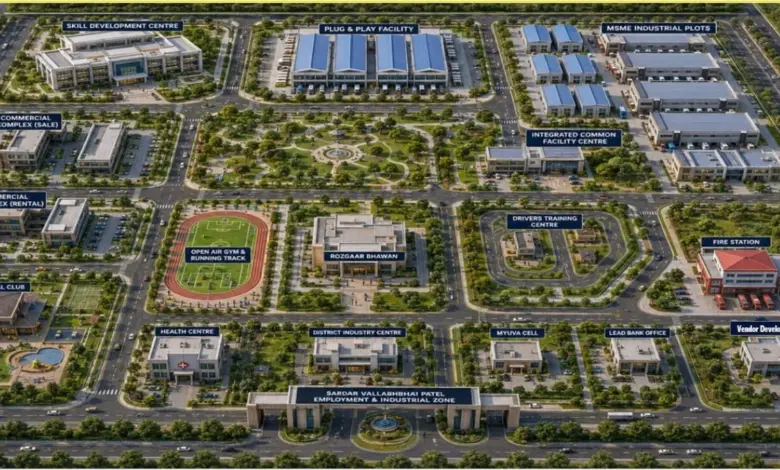
Lucknow | July 16, 2026 : The Uttar Pradesh government has unveiled an ambitious plan to reshape the state’s industrial landscape through the Sardar Vallabhbhai Patel Employment and Industrial Zone (SVPEIZ). The project will establish a nine-region hub-and-spoke industrial network that combines employment generation, skill development, industrial infrastructure, and entrepreneurship under one integrated model.
Announced during UP Diwas 2026, the initiative aims to create region-specific industrial ecosystems while strengthening manufacturing and employment opportunities across the state. The project will be implemented in phases through agencies including UPSIDA, UPEIDA, YEIDA, GNIDA, and GIDA.
What is the Sardar Vallabhbhai Patel Employment and Industrial Zone?
The Sardar Vallabhbhai Patel Employment and Industrial Zone is a large-scale industrial development initiative that connects nine economic regions of Uttar Pradesh through a hub-and-spoke model.
Instead of concentrating industries in a few cities, the government plans to develop multiple regional hubs based on local strengths, available resources, and investment potential. This approach will improve balanced regional development while creating employment opportunities closer to people’s homes.
Vision Behind the Project
The state government designed the project to integrate:
- Skill development
- Industrial infrastructure
- Employment services
- Entrepreneurship support
- Manufacturing ecosystems
As a result, industries will gain access to skilled manpower while young professionals will find better employment opportunities within their own regions.
Nine Industrial Regions Identified
The Sardar Vallabhbhai Patel Employment and Industrial Zone will cover nine industrial regions across Uttar Pradesh.
These include:
- Gautam Buddh Nagar
- Ghaziabad–Meerut
- Moradabad–Bareilly
- Agra–Aligarh
- Lucknow–Ayodhya
- Kanpur–Prayagraj
- Chitrakoot–Jhansi–Vindhyachal
- Varanasi–Azamgarh
- Gorakhpur–Basti–Devipatan
Each region will specialize in industries that match its economic strengths, natural resources, and investment opportunities. Therefore, industrial growth will become more focused and sustainable.
First Phase to Establish 16 Integrated Centres
The project will begin with 16 integrated Employment and Industrial Centres across Uttar Pradesh.
The development responsibilities have been divided among key industrial agencies:
- Five centres by UPSIDA
- Five centres by the MSME Department
- Two centres by UPEIDA
- Two centres by YEIDA
- One centre by GNIDA
- One centre by GIDA
This collaborative approach will speed up implementation while ensuring regional balance.
Hub-and-Spoke Model Explained
The Sardar Vallabhbhai Patel Employment and Industrial Zone follows a hub-and-spoke model.
Under this framework, every industrial hub will serve as the primary manufacturing and employment centre. Nearby districts will function as support zones for skill development, ancillary industries, logistics, and workforce supply.
Consequently, industries and local economies will remain closely connected. Businesses will benefit from better supply chains, while workers will gain easier access to employment opportunities.
Facilities Planned in Every SVPEIZ Centre
Each SVPEIZ will function as a complete industrial ecosystem.
The government plans to develop:
Skill Development Institutes
Training centres will prepare youth for industry-ready jobs through technical and vocational programmes.
Industrial Plots and Plug-and-Play Sheds
Ready-to-use industrial infrastructure will help investors begin operations quickly.
Employment Facilitation Centres
Dedicated employment centres will connect skilled workers with industries operating inside the industrial zones.
Entrepreneurship Support
The project will encourage startups and MSMEs by providing business support services, incubation, and common infrastructure.
Special Purpose Vehicles to Oversee Development
The government plans to establish Special Purpose Vehicles (SPVs) for every industrial hub.
Lead investors will chair these SPVs and oversee planning, construction, infrastructure creation, and operational management. Construction will begin wherever land is readily available, while skill development programmes will run alongside infrastructure development.
Benefits for Uttar Pradesh’s Economy
The Sardar Vallabhbhai Patel Employment and Industrial Zone is expected to deliver long-term economic benefits.
It will:
- Generate large-scale employment
- Attract domestic and global investment
- Strengthen MSMEs
- Improve industrial competitiveness
- Enhance regional manufacturing capacity
- Reduce migration toward major cities
- Promote balanced economic development
Furthermore, industries will gain access to skilled workers trained according to sector-specific requirements.
Strengthening Uttar Pradesh’s Industrial Vision
The new employment zone complements Uttar Pradesh’s broader industrial strategy, which includes expressway-led development, industrial corridors, logistics parks, defence manufacturing, and the state’s single-window investment system.
Together, these initiatives aim to position Uttar Pradesh among India’s leading manufacturing and investment destinations.
Project Snapshot
| Feature | Details |
|---|---|
| Project | Sardar Vallabhbhai Patel Employment and Industrial Zone (SVPEIZ) |
| Model | Nine-region hub-and-spoke industrial network |
| Regions Covered | 9 |
| Phase One Centres | 16 |
| Implementing Agencies | UPSIDA, MSME Department, UPEIDA, YEIDA, GNIDA, GIDA |
| Core Focus | Employment, Skill Development, Manufacturing, Entrepreneurship |
Why This Project Matters
The Sardar Vallabhbhai Patel Employment and Industrial Zone represents a major shift in Uttar Pradesh’s industrial planning. Instead of concentrating development in a few cities, the state is building interconnected regional growth centres that combine jobs, skills, infrastructure, and investment. If implemented successfully, the project could transform Uttar Pradesh into one of India’s strongest manufacturing and employment hubs while ensuring inclusive regional development.
Sustainable Aviation Fuel Policy in Uttar Pradesh: A Game-Changer or Growing Pains for MSMEs?