
Rashtra Prerna Sthal: From Waste to National Inspiration
How a forgotten dumping ground was transformed into a symbol of national pride, governance, and inspiration under PM Modi.

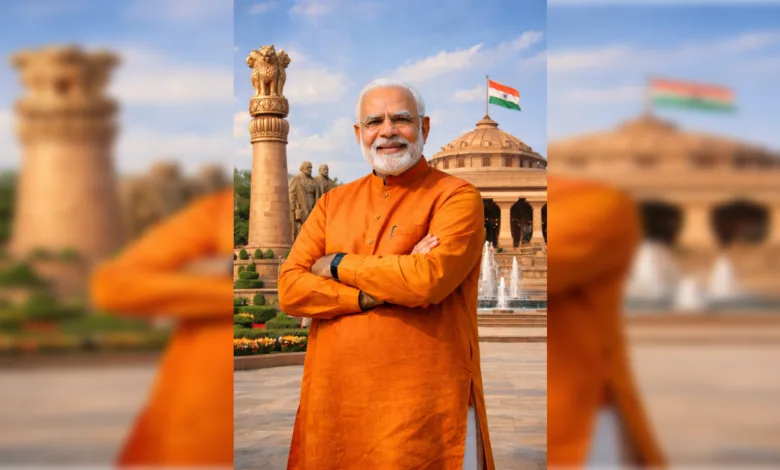
There are places that history forgets — not because they lack significance, but because neglect slowly erases their presence from collective memory. Then there are moments when political will, vision, and symbolism converge to reclaim such spaces and redefine their meaning. Rashtra Prerna Sthal is one such place. Recently inaugurated by Prime Minister Narendra Modi, it stands today not merely as a physical landmark but as a powerful metaphor of transformation — from waste to worth, from neglect to national pride.
This feature article traces the long and layered journey of Rashtra Prerna Sthal: a site once known as a waste dumping ground, now reimagined and rebuilt as a centre of national inspiration under the Bharatiya Janata Party’s governance. Its story is not only about land reclamation, but about ideology, governance, symbolism, and the politics of space.
A Forgotten Landscape of Waste and Neglect
Before it became Rashtra Prerna Sthal, the land told a very different story. For years, it functioned as a dumping site — a place where urban waste accumulated, both literally and symbolically. Piles of garbage, environmental degradation, foul odours, and visual decay defined the area. It was not a destination, not a point of pride, and certainly not a space of reflection. Like many dumping grounds across India, it existed on the margins of public consciousness.
Dumping sites are often the physical manifestation of governance gaps. They represent rapid urbanisation without parallel planning, consumption without accountability, and civic spaces abandoned to convenience. Over time, such places stop appearing in public conversations. They become invisible, even as they continue to expand.
For nearby residents, the dumping site was a reminder of what development often leaves behind. For city planners, it was a problem best postponed. Few imagined that the same land could ever become a site of national importance.
The Power of Reimagining Space
The transformation of this dumping ground into Rashtra Prerna Sthal began with a fundamental shift in perspective. Instead of viewing the land as a liability, it was reimagined as an opportunity. This shift reflects a broader governance philosophy associated with the BJP — one that emphasises reclaiming neglected spaces and reinvesting them with cultural, national, and ideological meaning.
The idea was not merely to clean the area or beautify it superficially. The objective was deeper: to convert a space associated with waste into one associated with inspiration. This required more than engineering and landscaping. It demanded a narrative — a story that citizens could connect with.
The very name, Rashtra Prerna Sthal, signals this intent. It positions the site not as a park or memorial alone, but as a place where national consciousness can be experienced and renewed.
BJP’s Governance Philosophy and Symbolism
Under the BJP, public spaces have increasingly been treated as carriers of meaning. Roads, corridors, ghats, statues, memorials, and redeveloped urban zones are not seen merely as infrastructure but as symbols of cultural assertion and governance outcomes.
Rashtra Prerna Sthal fits seamlessly into this approach. The BJP’s political narrative often revolves around transformation — transforming systems, mindsets, and spaces. By highlighting what the land once was and what it has become, the party reinforces its claim of decisive governance.
The site’s transformation also aligns with the BJP’s emphasis on national pride, discipline, and reclaiming dignity. The act of clearing waste, restoring land, and dedicating it to national inspiration mirrors the party’s ideological messaging of cleansing inefficiency and restoring confidence.
Narendra Modi’s Inauguration: A National Moment
Prime Minister Narendra Modi’s inauguration of Rashtra Prerna Sthal elevated the project from a local redevelopment initiative to a national statement. Modi’s leadership style has consistently used inaugurations as storytelling moments — opportunities to highlight journeys of struggle, resolve, and achievement.
By inaugurating a site that once symbolised neglect, Modi reinforced a central theme of his governance: that no challenge is too entrenched to be addressed with determination. His presence at the inauguration signalled that the transformation of forgotten spaces is as important as large-scale industrial or economic projects.
The event also positioned Rashtra Prerna Sthal within the larger narrative of New India — an India that does not accept decay as destiny, and that seeks renewal even in the most unlikely places.
Architecture That Communicates Meaning
The design of Rashtra Prerna Sthal avoids excessive grandeur. Instead, it focuses on clarity, openness, and symbolism. The architecture is meant to guide visitors through a journey rather than overwhelm them. Open pathways, restored green areas, and thoughtfully designed spaces encourage reflection.
This architectural restraint is deliberate. Inspiration, after all, is not always loud. Sometimes it emerges from balance and order. The transformation of uneven, polluted terrain into a harmonious landscape communicates discipline and patience — values the site seeks to embody.
Every restored patch of land, every carefully planned element, stands as a silent rebuttal to the belief that decay is irreversible.
Environmental Recovery and Responsibility
One of the most significant aspects of Rashtra Prerna Sthal is its environmental dimension. Reclaiming a dumping ground is among the most challenging forms of urban redevelopment. It involves waste removal, soil treatment, environmental stabilisation, and long-term ecological planning.
The successful conversion of this site highlights an important lesson: environmental damage can be reversed when policy intent aligns with execution. The project sends a message that development and environmental responsibility are not mutually exclusive.
In a time when cities across India struggle with landfills and waste management, Rashtra Prerna Sthal offers a template — not just of cleanup, but of meaningful reuse.
Political Will and Administrative Execution
Projects of this scale do not succeed without sustained political will. Transforming a dumping site into a public landmark requires coordination across departments, consistent funding, and long-term planning.
The BJP has often projected itself as a party capable of executing long-pending or politically inconvenient projects. Rashtra Prerna Sthal strengthens that projection. Cleaning and redeveloping a dumping ground is rarely glamorous, yet the government chose to invest effort and resources into it.
This decision reflects a preference for long-term impact over short-term optics.
Public Spaces and National Consciousness
Public spaces shape how citizens experience their nation. Memorials, parks, and cultural centres communicate values through design and use. Rashtra Prerna Sthal seeks to function as a shared civic space where national ideals are not imposed but encountered.
Unlike closed monuments, it allows repeated engagement. People can visit, return, and reinterpret its meaning over time. In doing so, the site becomes part of living public memory rather than a static structure.
Its transformation from margin to meaning reinforces the idea that national identity is built not only in capitals and corridors of power, but also in reclaimed spaces.
From Utility to Symbol
Dumping grounds serve a grim utility — hiding what society prefers not to confront. Rashtra Prerna Sthal represents the opposite impulse: confronting neglect and transforming it into purpose.
The shift from concealment to celebration marks a psychological turning point. It invites citizens to reconsider how they relate to their environment and to governance.
By investing symbolic value in this site, the BJP has turned an administrative challenge into a political and cultural statement.
Debate, Criticism, and Democratic Discourse
As with any politically significant project, Rashtra Prerna Sthal has generated debate. Critics argue that inspirational spaces should not distract from essential services. Others question whether symbolism translates into everyday improvement.
Supporters counter that societies need symbols to sustain collective motivation. Infrastructure addresses needs; inspiration shapes direction. In this view, Rashtra Prerna Sthal complements development rather than competes with it.
The very existence of such debate reflects the site’s significance in public discourse.
Cultural Resonance and Civilisational Context
India’s civilisation has long valued spaces of contemplation — from ghats and gardens to memorials and sabhas. Rashtra Prerna Sthal draws from this tradition while framing it within a contemporary national narrative.
Its emphasis on inspiration rather than instruction allows diverse interpretations. For some, it represents environmental recovery. For others, political resolve. For many, it is simply a reminder that public spaces matter.
This layered meaning enhances its cultural longevity.
A Blueprint for Urban Transformation
Beyond symbolism, Rashtra Prerna Sthal serves as a practical model. Cities across India face similar challenges with neglected dumping sites. This project demonstrates that such spaces can be reclaimed if governance intent is clear.
The key lesson lies not merely in construction but in imagination — the ability to see potential where others see burden.
If replicated thoughtfully, such transformations could redefine urban landscapes across the country.
BJP’s Narrative of Change
For the BJP, Rashtra Prerna Sthal strengthens its central narrative: that of decisive action and visible change. The before-and-after story is powerful precisely because it is tangible.
In political communication, visible transformation often carries more weight than abstract data. This site allows the government to point to physical evidence of its governance philosophy.
It reinforces the idea that change is not theoretical — it can be walked through, seen, and experienced.
The Visitor’s Emotional Journey
Visitors to Rashtra Prerna Sthal encounter more than a landscaped area. They walk through a story of recovery. Knowing the site’s past adds depth to the experience.
What was once avoided is now approached with curiosity and pride. This emotional reversal lies at the heart of the site’s purpose.
Inspiration, here, emerges not from grandeur alone but from contrast.
Sustaining Inspiration Beyond Inauguration
An inauguration marks a beginning, not an end. The future relevance of Rashtra Prerna Sthal will depend on sustained care, programming, and engagement.
Inspirational spaces require attention to remain meaningful. If maintained thoughtfully, the site can continue to evolve — hosting reflection, dialogue, and quiet moments of connection.
The challenge lies in ensuring that inspiration does not fade into routine.
Reclaiming Land, Reclaiming Belief
Rashtra Prerna Sthal stands today as a testament to the power of vision-driven governance. Its journey from waste dumping ground to national inspirational space mirrors a larger political promise — that decline can be reversed and dignity restored.
Through this transformation, the BJP and Prime Minister Narendra Modi have presented a compelling narrative of renewal. Whether viewed as environmental redemption, urban renewal, or political symbolism, the site commands attention.
Ultimately, Rashtra Prerna Sthal is about more than land. It is about belief — belief in change, in public spaces, and in the idea that even the most neglected corners can be reimagined with purpose.
In a nation balancing its past and future, such spaces matter. They remind citizens that inspiration, like land, can be reclaimed — if the will exists to clear away the debris and see possibility beneath it.
Also Read : Anandiben Patel: The Quiet Custodian of Uttar Pradesh’s Rise